The Smart Zone Problem: Why Your AI Gets Dumber After 80,000 Tokens
You're working with Claude Code. The conversation starts sharp. The model understands your codebase, suggests clean refactors, catches edge cases you missed.
Then something shifts.
The suggestions get vaguer. It starts repeating itself. It forgets what you discussed three exchanges ago. Then it says "You're absolutely right" and proceeds to suggest something completely unrelated to your actual problem.
You're still in the same conversation, but the intelligence has drained out.
You didn't break the model. You hit the smart zone limit.
The Attention Budget Is Real
Large language models have a context window—the total amount of text they can hold in memory at once. Claude's latest models (Opus 4.6 and Sonnet 4.6) now support 1 million tokens. Sounds like a game-changer, right?
But here's the problem: the model doesn't process all those tokens equally.
Think of it like a football league where every team has to play every other team. With 5 teams, you need 10 matches. With 10 teams, you need 45 matches. With 20 teams, you need 190 matches.
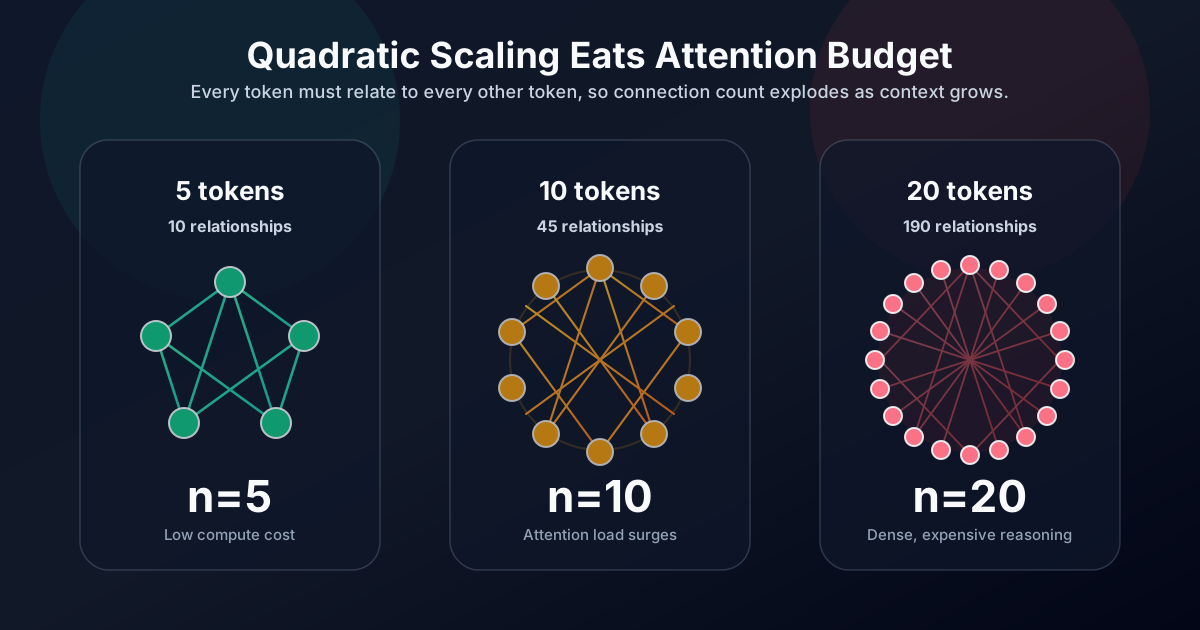
This is quadratic scaling. Every new token has to relate to every other token in the context window. The computational cost explodes.
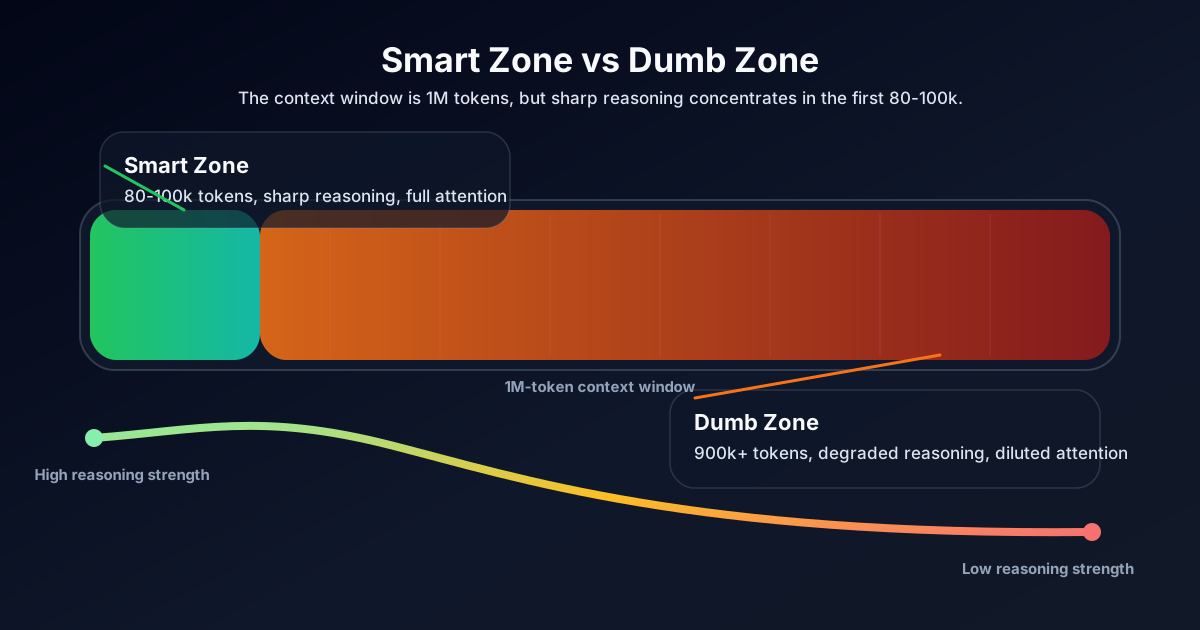
Around 80,000 to 100,000 tokens—the model's reasoning starts to degrade. Beyond that threshold, you're in serious trouble. The relationships between tokens become strained. Attention gets diluted. The model loses coherence.
This isn't a bug. It's physics.
The Smart Zone vs. The Dumb Zone
The smart zone is where the model has enough attention budget to work sharply. It can track multiple threads, reason through complex logic, and maintain context across exchanges.
The dumb zone is where attention relationships break down. The model starts hallucinating. It forgets what you said earlier. It gives generic answers because it can't hold the full picture anymore.
The smart zone extends to around 80,000 to 100,000 tokens. Everything beyond that is borrowed time.
And here's the kicker: you don't control when you cross that line. Every message, every file you add to context, every line of code the model reads—it all counts against your budget.
You can't see the token counter ticking up. You just notice the quality drop.
What This Means for Your Workflow
If you're treating Claude Code like a persistent coding partner, you're working against its nature.
Every conversation has a shelf life. You can't just keep adding context and expect the same quality. At some point, you need to reset.
This changes how you structure your work:
Start fresh for new problems. Don't drag 50,000 tokens of old context into a new task. The model will spend its attention budget on irrelevant history instead of the problem in front of it.
Keep conversations focused. One problem, one conversation. Don't try to refactor three different modules in the same thread. You'll hit the dumb zone faster.
Provide context deliberately. Don't dump your entire codebase into the window. Give the model exactly what it needs to solve the current problem—nothing more.
Watch for quality drops. If the model starts repeating itself or giving vague answers, you've probably crossed into the dumb zone. Reset the conversation.
The 1 Million Token Reality
Claude recently shipped 1 million token context windows for Opus 4.6 and Sonnet 4.6. The marketing makes it sound revolutionary.
Here's what they actually shipped: a lot more dumb zone.
The smart zone is still around 80,000 to 100,000 tokens. The context window limit is just a ceiling—how much the model can technically hold. But the smart zone threshold—where attention relationships start breaking down—remains relatively fixed.
You can fit 10x more into the conversation now. But the model won't reason sharply about most of it. The first 80-100k tokens get the full attention budget. Everything beyond that gets progressively worse reasoning quality.
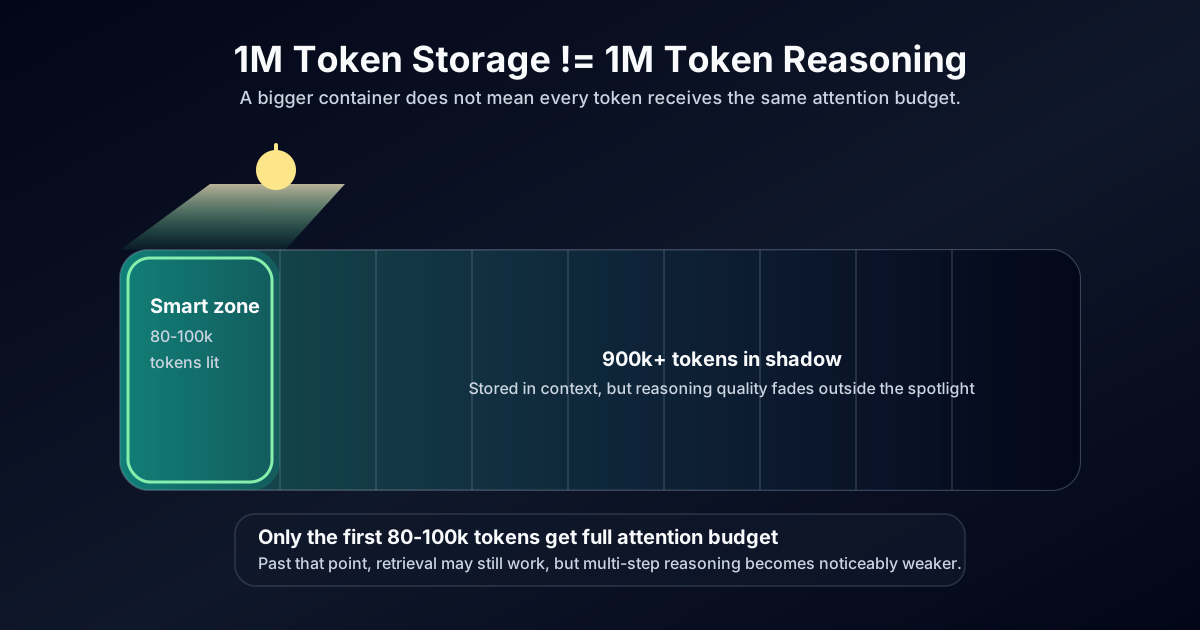
It's like having a massive warehouse but only one spotlight. You can store more, but you can't illuminate it all at once.
Working With the Constraint
The smart zone problem isn't going away. It's a fundamental property of how these models work.
But you can design around it:
Treat conversations as disposable. Don't try to maintain a single thread for hours. Reset when quality drops.
Optimize for clarity, not volume. A small, well-structured context beats a massive, unfocused one every time.
Build feedback loops. Test the model's output early and often. Catch quality drops before they compound.
Understand the trade-off. More context means worse reasoning. Sometimes less is more.
The Real Lesson
LLMs aren't junior developers. They're something fundamentally weirder.
They have perfect recall within a narrow window and no memory beyond it. They reason sharply up to a point, then degrade predictably. They don't get tired, but they do get dumber as the conversation grows.
Understanding this constraint changes how you work. You stop expecting the model to behave like a human. You start designing workflows that play to its actual strengths.
The smart zone is real. Work within it, and Claude Code is a powerful tool. Ignore it, and you'll wonder why your AI keeps getting dumber.
What's the longest conversation you've had with an LLM before noticing quality drop? How do you decide when to reset?